
2025–2027 FMOP: Engagement and Outcomes
WHAT WAS PLANNED, WHAT WE HEARD AND WHAT HAPPENED NEXT
Forests sustain wildlife, clean water, livelihoods and community life while supporting hunting, trapping, fishing, gathering, teaching and ceremony. For First Nations, these forests are ancestral territories where Treaty and inherent rights are exercised and responsibilities to the land continue across generations. People who live with and care for the forest hold knowledge that technical maps cannot capture. Bringing this knowledge into forest management is essential to meaningful engagement and informed decision-making.
What is an FMOP?
A Forest Management Operating Plan (FMOP) identifies where work may occur and the measures that guide it. Decisions depend on field conditions, required authorizations, updated wildlife information and research, feedback from rights holders and other participants, contractor capacity, mill fibre requirements, and changing circumstances such as wildfire and natural disturbance.
The 2025–2027 FMOP covers planned activities within Forest Management Licence area No. 2 over a two-year operating period. It includes planned and contingency timber harvest areas, road and water-crossing construction, road decommissioning and forest renewal activities.
What are the community information meetings for?
Before submitting a FMOP, NFMC holds meetings so First Nations rights holders, Métis citizens, communities, land users and the public can review proposals, examine maps, ask questions, identify important places and raise concerns. This brings local and Indigenous knowledge into planning where technical information may be incomplete.
The meetings support participation and information-sharing but do not replace the Crown’s constitutional duty to consult First Nations and Métis rights holders. The Government of Manitoba remains responsible for Crown consultation and approval of the FMOP.
What did we hear?
From December 2024 to February 2025, NFMC conducted engagements with 12 community groupings across and near Forest Management Licence area No. 2. Additional engagements involved the Sustainable Forest Management Committee and the Manitoba Métis Federation. Participation varied across the sessions, reinforcing the importance of continued outreach and opportunities for involvement.
Participants raised concerns and asked questions about traplines, cabins, trails, harvesting locations, roads, water crossings, wildlife habitat, hunting and fishing pressure, herbicide use, forest renewal, employment, wildfire, protected areas and long-term forest health.
Questionnaire respondents ranked wildlife and hunting as their highest priorities, followed by trapping, water quality, and parks or protected areas. The results reflect the views of respondents, not every community or rights holder.
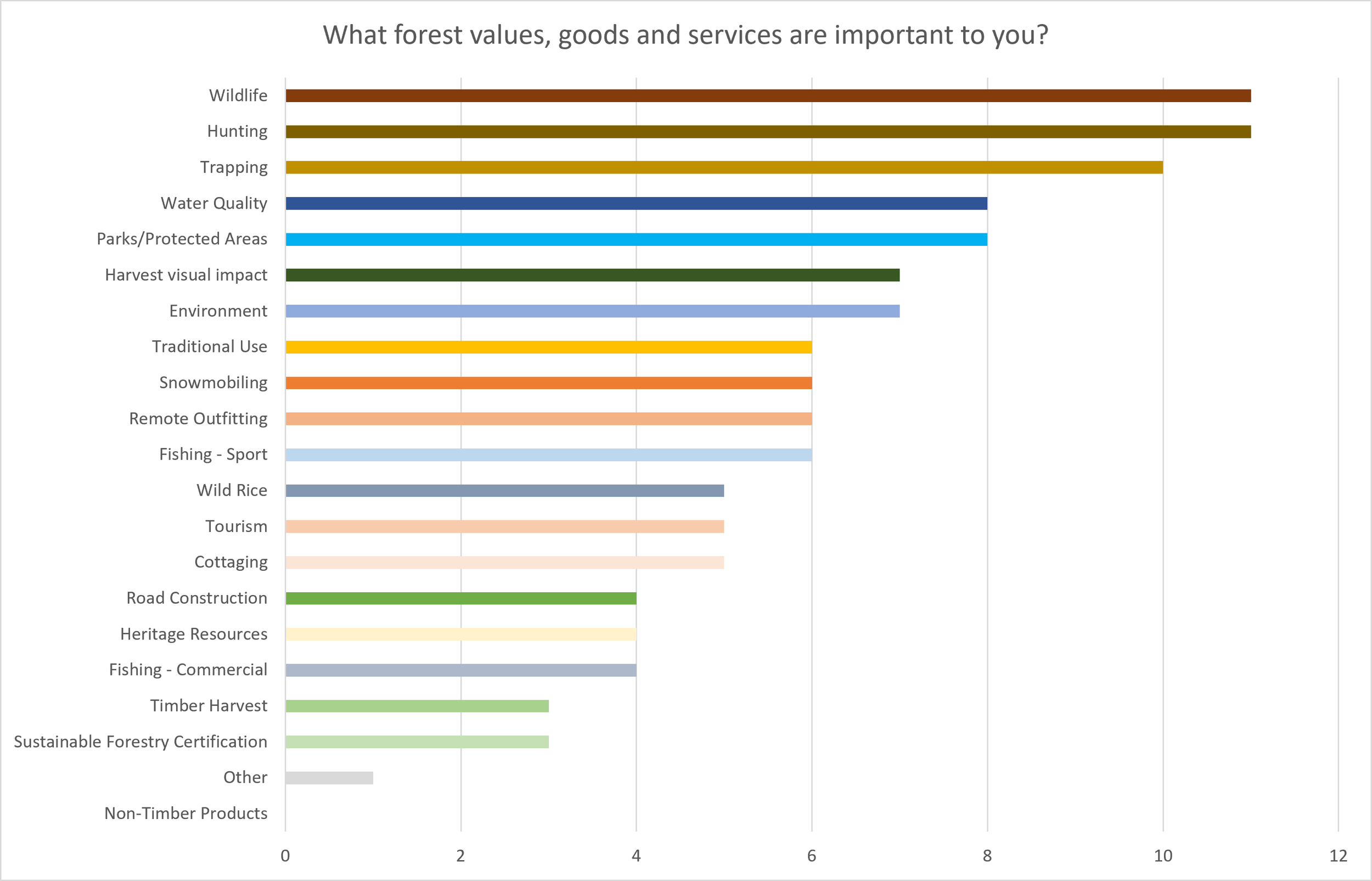
2024/25 FMOP meeting questionnaire results
What happened with the information?
Questions and concerns are documented for follow-up. Information may lead to a mapping check, field review, further land-user communication, operational planning or continued discussion. The record shows several concrete examples:
Multiple traplines, camps, outfitting areas and bear-bait sites were recorded for operational review and future notification.
A snowmobile trail near a proposed work area was identified, prompting NFMC to coordinate with the local snowmobile club before forestry activities begin nearby.
NFMC clarified that active trails near roads proposed for decommissioning would not automatically close.
Missing map features identified by Opaskwayak Cree Nation were flagged for verification and mapping updates.
Sapotaweyak received follow-up information about youth education, training and possible participation in tree planting and forest renewal.
Some questions provided an opportunity to explain the safeguards already built into forest planning, including wildlife buffers, pre-harvest field investigations and provincial environmental requirements. These discussions also clarified how concerns are considered before forestry activities proceed.
NFMC publishes its Sustainable Forest Management Annual Report on its website each year. The report includes a Public Concerns Table that provides a detailed record of concerns raised, potential impacts and mitigation measures.
Other matters will require continued communication and follow-up, including concerns about increased hunting and fishing pressure associated with forestry roads and reaching land users who may be affected. Keeping these conversations open will help NFMC strengthen relationships and improve future planning and engagement.
Approval and the work ahead
Manitoba approved the 20252027 FMOP with conditions covering continued Indigenous engagement, vegetation management notification, protected areas, roads, water crossings, decommissioning and harvest limits. These provincial requirements should not all be attributed directly to community input.
After NFMC received provincial approval for the 20252027 FMOP, communities and organizations were notified of the approval and given access to the approved plan and accompanying maps. The FMOP is in effect from June 1, 2025, to May 31, 2027, and NFMC will continue to welcome questions, discussion and participation throughout this period.
The 2025 wildfire season affected planned operations, showing why an FMOP must respond to changing conditions. For NFMC, continuous improvement means engaging early, reaching more people, making technical information easier to understand, documenting follow-up and showing more clearly what changed, what did not change and why.
People can stay involved by attending future meetings, reviewing maps, identifying local values or concerns, requesting follow-up and keeping contact information current for notice about nearby operations. This supports NFMC’s journey toward Two-Eyed Seeing—bringing Indigenous knowledge, lived experience and rights together with Western science and forestry practice, while respecting the strengths of each. That work is not completed through one meeting cycle. It depends on lasting relationships, honest reporting and accountability.
Work on the next Forest Management Operating plan for 2027-2029 is starting this fall. Stay tuned for updates and the meeting schedule.